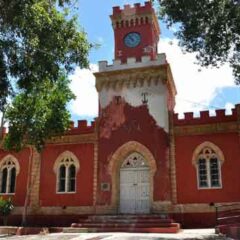
Government House is a neoclassical white structure with intricate ironwork along the balconies. It is a perfect example of the grandeur of official buildings during colonial time. Government House was erected between 1865 and 1867 as a meeting place for the Danish Colonial Council. It replaced an earlier building, dated 1819, of the same function and was renovated in 1994. Paintings and murals by Camille Pissarro adorn several walls in the house. Visitors must check in with the security officer at the entrance and are allowed into the lobby only. The lobby contains paintings of the present and former governors. Open 8am-5pm on weekdays with the exception of holidays.
Once the home of a Danish artisan, the house has been converted into a museum. The 18th century Danish house is a two-story yellow brick-and-stone structure. Named for the seven arches that support it's "welcoming arms" staircase, the house has been restored to its original condition. The museum provides a wonderful example of West Indian architecture. It features antique furnishings and a balcony view of the beautiful harbor. The owners reside in the home and offer tours. A small donation is requested.
Blackbeard's Castle is the remains of Fort Trygborg, built around 1679 as a supplementary watch tower. It is located at the top of Government Hill and offers spectacular views of the Charlotte Amalie Harbor. The view is the reason it was built there, so Danish soldiers could keep an eye out for enemy ships and protect Fort Christian from attacks. It is a National Historic Site and considered to be one of the oldest buildings on St. Thomas. The name Blackbeard refers to Edward Teach, a pirate who is said to have frequented the islands and spent quite a bit of time around the tower. It is not known exactly when the tower started being called Blackbeard's Castle, but it has become island lore that the pirate used the tower himself to keep an eye out for ships. There are life size statues of pirates around the garden area.
Blackbeard's Castle is affiliated with Villa Notman, Villa Britatania, Haagensen House and Hotel 1829. They are restored 1800's town house museums.
Villa Notman was built by Scottish engineer, Robert Notman in 1860. He came to St. Thomas to help build what is today the West Indian Company Dock. The house is built of a native stone called 'blue bitch' and yellow ballast brick. The top floor of the house is a museum that showcases four exhibit rooms of period furniture.
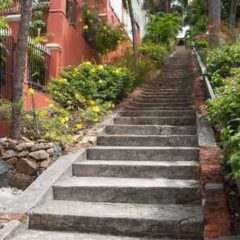
The Haagensen House was built by Danish banker Hans Haagensen, in 1827. Haagensen had been sent to St. Thomas from Copenhagen to help run the official Bank of St. Thomas. There are five period exhibit rooms furnished with beautiful antiques. There is an impressive view of the harbor from this historic property. The house is surrounded by terraced gardens. It is located near the top of the 99 steps.
This beautiful church is well known for its large columns and classical revival style architecture. The front of the building imitates a Roman temple. The congregation dates back to the late 1600s and the building itself to 1844.
Sephardic Jews constructed this temple in 1833 after the original structure was destroyed by fire. The original structure was built in 1796. It is the second-oldest synagogue in the Western Hemisphere and the oldest continuously used Synagogue under the American Flag. The official name is Brachah V'Shalom U'gmilut Chasadim, meaning Blessing and Peace and Loving Deeds. The temple played an important role in the spiritual life of the Jewish community during Danish colonialism. Keeping with the tradition of the Sephardic Jews, the floor of the Synagogue is covered with sand. The sand symbolizes the ancient flight of the Jewish people out of Egypt and across the desert.
The Square is the original site of a busy slave market where African slaves were sold to the highest bidder. The auction block has been roofed, and now the square serves as an open-air market. Saturday is the busiest day, but local venders of fruits and vegetables can be found there almost every day.
Just next to Market Square is the former St. Thomas Bank building, a two story building dating back to the mid-1800s.
Sts. Peter and Paul Catholic Cathedral was built in 1806 and has for the most part remained open since that time. Hand-painted murals from 1901 were created by Belgian artists Fr. Leo Servais and Brother lldephonsus. Beautiful stain-glass windows honoring the patron saints Peter and Paul were added in the 1960s. The Sts. Peter and Paul Catholic School is located beside the Cathedral.